When the cold of the winter months hits, homeowners are quick to fire up their furnaces. Studies show that most American households use natural gas furnaces or electric furnaces as two of their primary heat sources during the winter. However, when homeowners rely on the same furnace year after year, these appliances begin to age, slowly approaching the end of their life cycles.
While this decline is completely natural, an unexpected furnace breakdown in the dead of winter can make for a freezing few days and high costs. That's why it's crucial to know the average life span of a furnace, recognize the signs of a needed replacement or repair and implement the proper maintenance to maximize your furnace life expectancy.
The average furnace life span is about 10 to 12 years. However, furnace types differ by fuel consumption, giving them different life expectancies.
Knowing how long each type of furnace lasts is essential for preparing you for the end of your furnace's service life while helping you weigh your options for a new furnace in the future.
As their name implies, oil furnaces convert oil into heat. The oil ignites in the combustion chamber while the heat exchanger warms the gas or water. The fan then pulls air from the house and blows it over the heating elements to transform it into hot air. Oil-fired furnaces are particularly popular in geographic areas like the northeast, where access to natural gas is limited.
Though most manufacturers will offer a 10-year warranty on oil furnaces, your unit should last longer. If you own an oil furnace, you can expect to get at least 15 years of use out of your appliance at a minimum.
While an oil furnace can function for over 10 years, most aren't likely to perform as well past this point. If your oil furnace lasts more than 10 years, you've been doing the proper maintenance!
Oil furnaces are more likely to reach the upper end of their average life span when you change their filters every two to three months. It's also important that your oil furnace is sized to match your home's dimensions. That's because an oil furnace that's too small will work harder to heat a large house, increasing the risk of premature furnace failure. If your furnace is too large for your home, it may use more energy than necessary.
Electric furnaces use electricity as a heat source for achieving temperatures high enough to melt metal alloys without producing an electrochemical effect. There are two primary types of electric furnaces — arc furnaces and high-frequency induction furnaces.
The life expectancy of an electric furnace is typically 10-12 years, giving it a greater chance of prolonged use compared to other furnace types. This extensive life cycle can be attributed to its simple design. However, electric configurations with thinner linings trade a longer life span for higher power and constant voltage capabilities, giving them a shorter useful service life than those with thicker linings.
Gas furnaces ignite natural gas to generate and deliver heat throughout a home. These furnace types are known for their fast heating and economical prices.
The average life span of a gas furnace ranges from 10 to 12 years, though you may be able to gain additional years of service life with the proper care. However, it's wise to begin evaluating your furnace replacement options after your gas furnace hits the 10-year mark. Replacing your gas furnace at the lower end of its projected life expectancy reduces the risk of a complete breakdown.
It's vital to know how old your furnace is to determine how best to handle any operational issues that may come along. If you're not sure of your appliance's age, you can typically locate the manufacturer's serial number inside the furnace cover. If you present this number to a heating professional, they should be able to give you an accurate age.
Even if your furnace is 12 years old, it may still have a few years of life left in it, despite being on the upper end of its life expectancy. Your furnace's age may indicate the following characteristics.
No matter how old your furnace is, it's necessary to conduct regular maintenance to keep it operating at peak condition for as long as possible. Whether you perform this routine upkeep yourself or delegate it to a professional maintenance team, a well-maintained furnace will function more efficiently for longer, preventing the risk of unexpected failure.
Furnaces that break down before their projected life cycle may not have been maintained properly or enough during their service life.
While frequent maintenance is excellent for keeping your furnace in good shape, it also gives you a better idea of when a furnace replacement is required. When you or a professional works on your furnace regularly, you gain a better understanding of how effectively your furnace is functioning instead of basing this determination solely on its age. You'll get a comprehensive assessment of air filter cleanliness, fan system function and necessary repairs before any issues progress.
It's beneficial to know what type of furnace you have so you understand how to replace it when its time comes. For example, if you've had a gas furnace that served you well for 11 years, you may want to purchase the same model for your next investment or even buy a similar model with more updated components.
If your original furnace lasted under 12 years or didn't operate as efficiently as you wished despite delivering the proper maintenance, you may want to look for different furnace models with more dependable features. Investing in a sturdy, high-performing furnace is essential when replacing your old one.

If your furnace has reached or exceeded its maximum life expectancy, it was likely properly installed when it was new. That's because a furnace's quality of installation directly impacts its longevity.
An appliance that wasn't installed correctly will operate less efficiently than it's supposed to, causing the system to overwork itself. This overexertion results in greater component wear and tear, higher energy bills and premature burnout. That means that a furnace that breaks down in under 9 years may not have been installed properly when you first purchased it.
Be sure to hire qualified experts when purchasing and installing your residential furnace to protect your investment and increase its life span.
Newer furnaces tend to last longer than older ones. Better technologies have been incorporated into furnaces in recent years, helping them preserve their components, improve performance and ultimately increase system longevity.
Your furnace will likely last longer if it was built within the last 7 years, while it'll probably reach the end of its service life sooner if it was manufactured over a decade ago.
Furnaces will display various warning signs that indicate if they need to be repaired or replaced. It's vital to pay attention to these signs so you can take the proper action before it's too late.
You can gauge your furnace's replacement time and repair needs by looking for the following symptoms.
Just because something seems wrong with your furnace doesn't mean it's time to replace it completely. Even the most intimidating symptoms may take nothing more than a simple repair to resolve.
If you notice any of the following indicators, your furnace could likely use repairs:
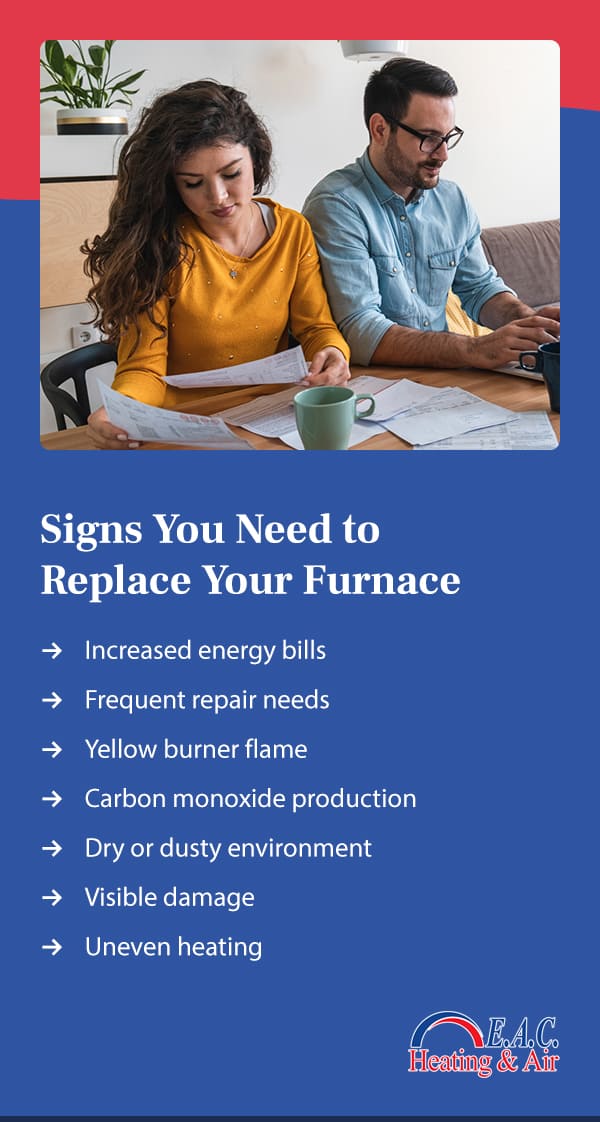
As a general rule of thumb, furnaces over 9 years old with repair needs costing over $500 should probably be replaced, as you'd get more value from a new furnace than you would by repairing your existing one. However, certain signs mean it's time for a replacement no matter how old your unit is.
If your furnace exhibits any of these symptoms, it's probably time to replace it entirely:
If you're looking to get the most out of your furnace, you can take various measures to better maintain your unit and ultimately increase your furnace life span. Try implementing the following strategies to protect and optimize your appliance.
The best way to ensure that your furnace functions properly in the long term is by scheduling heating system maintenance services from experienced professionals. HVAC companies are knowledgeable about the workings of your furnace, meaning they know exactly what to check and adjust to ensure that your furnace is in working order.
Getting a furnace tune-up every fall is an excellent way to catch any functional issues early so your unit is fixed and ready to go when the cold weather hits.
It's important to keep an eye on your furnace's air filters to monitor any dirt or grime buildup. If you notice that your filters are getting dirty, replace them immediately. When your filters are clogged with contaminants, they force your furnace to work harder to pump air through the house, causing components to wear faster and reducing your unit's service life.
It's a good rule of thumb to replace your air filters once a month to safeguard your system.
The harder you make your furnace work, the shorter its life expectancy. When you keep your furnace set at one temperature for most of the day, it doesn't have to work as hard as it would if you constantly adjusted the temperature.
In addition to setting consistent temperatures, you can also preserve your furnace by keeping your home's temperatures lower when you're not home to reduce wear and tear.
You can lessen the load for your furnace by ensuring that your home is adequately insulated so no air enters or escapes from the house. You can accomplish this by sealing any air leaks in your home with insulation. Common areas that often exhibit poor insulation include basements, attics, air ducts, windows and doors.
You can get the best life expectancy from your furnace with heating maintenance, repairs or installations from E.A.C. Heating & Air. We are a local, family-owned business dedicated to delivering the most reliable HVAC products and services for residential and commercial clients located in Hilton Head, Bluffton, and surrounding area.
Contact us to learn more about our offerings today!


